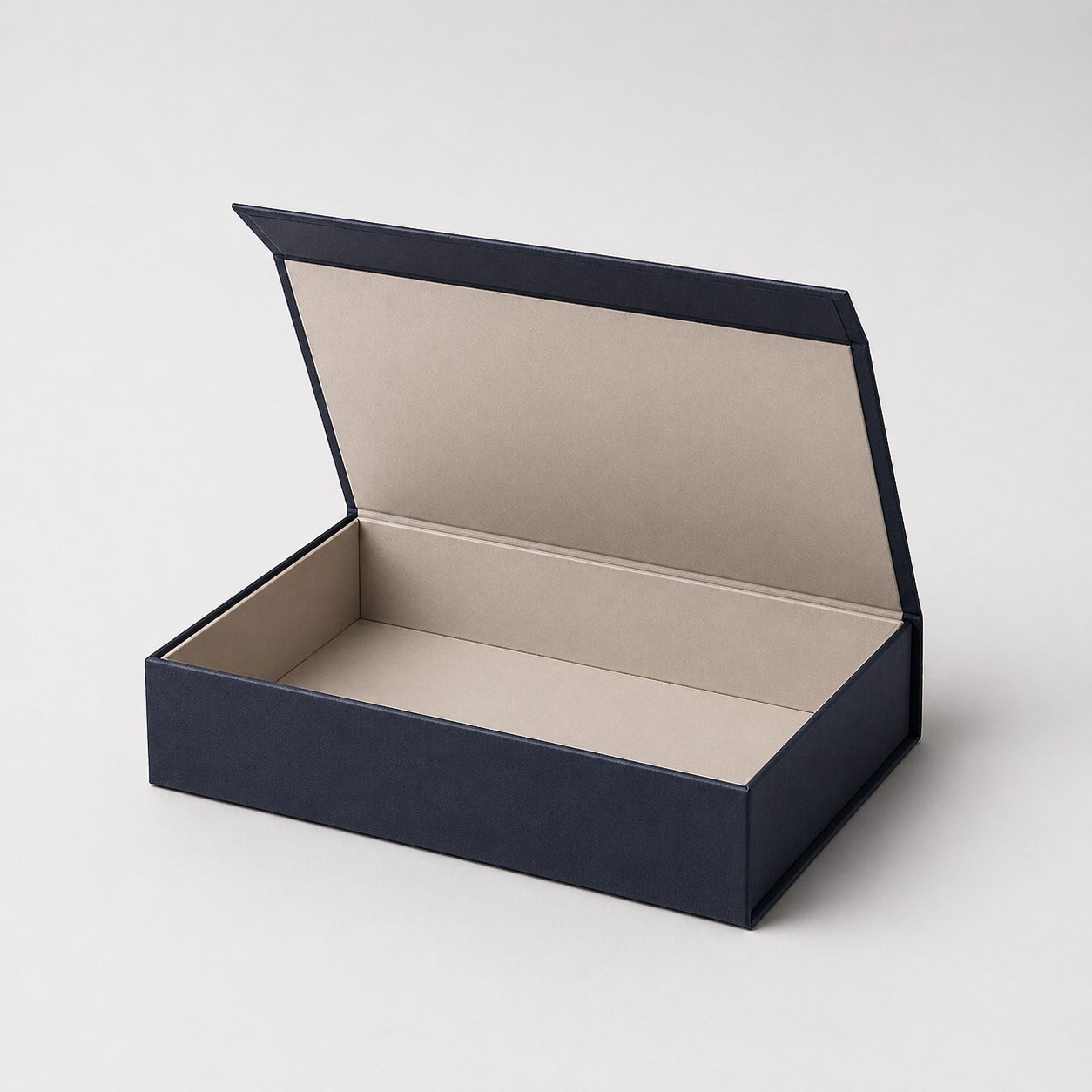

Six quality parameters as important as price when purchasing rigid cardboard boxes — and how to verify them.
When procuring rigid cardboard boxes at scale, price is only one variable. The following six quality criteria have a direct impact on product returns, brand perception, and long-term supplier reliability.
1. Grammage and Density
The outer covering paper should be a minimum of 157 gsm. Thinner coverings deteriorate over time, with corners showing wear first. The inner board density matters equally: low-density board collapses under load, distorting the box structure. Always request a technical specification sheet from your supplier at the quotation stage.
2. Lamination Adhesion Quality
Lamination quality reveals itself at corners and fold lines. A practical test: press a fingernail at the corner zone and try to lift the covering — quality lamination will not separate. When bent at 45°, no visible bubbling or delamination should occur between covering and board. Ask your supplier about lamination performance under heat and humidity.
3. Corner and Edge Workmanship
Whether corners are hand-made or machine-made significantly affects consistency. Machine production holds a 90° ± 1 mm tolerance reliably; hand production increases that variance. Corner accuracy affects not only appearance but also stacking performance and fit into display systems. Inspect all corners with a corner gauge during sample approval.
4. Magnet Strength and Alignment
For magnetic closure boxes, the magnet grade should be N35 or N38. Weaker magnets lose holding force within weeks of regular use. Central alignment when the lid closes is essential — a misaligned magnet creates both a visual defect and an incomplete seal. Test: run 50 consecutive open-close cycles and verify magnet seating and alignment afterward.
5. Interior Surface Quality
Interior lining materials (velvet, paper, or foam) tend to delaminate not at production but during use. Peeling at fold points and high-contact zones is a common source of customer complaints. Test: repeatedly fold the interior lining and apply a bending stress — quality adhesion will not initiate peeling.
6. Dimensional Tolerance
Inner and outer dimension tolerance should not exceed ±1 mm. This is especially critical for chain retail operations where boxes from different supplier batches must fit the same shelf system or insert fixture. Out-of-tolerance boxes cause operational delays and extra labor costs. Require dimensional verification on a minimum pre-production run of 10 units before approving full production.
Share these six criteria with your supplier at the quotation stage and convert them into a technical specification document. At Emsa Pack, sample approval is mandatory before every order — specify this at the quotation stage.
1. Grammage and Density
The outer covering paper should be a minimum of 157 gsm. Thinner coverings deteriorate over time, with corners showing wear first. The inner board density matters equally: low-density board collapses under load, distorting the box structure. Always request a technical specification sheet from your supplier at the quotation stage.
2. Lamination Adhesion Quality
Lamination quality reveals itself at corners and fold lines. A practical test: press a fingernail at the corner zone and try to lift the covering — quality lamination will not separate. When bent at 45°, no visible bubbling or delamination should occur between covering and board. Ask your supplier about lamination performance under heat and humidity.
3. Corner and Edge Workmanship
Whether corners are hand-made or machine-made significantly affects consistency. Machine production holds a 90° ± 1 mm tolerance reliably; hand production increases that variance. Corner accuracy affects not only appearance but also stacking performance and fit into display systems. Inspect all corners with a corner gauge during sample approval.
4. Magnet Strength and Alignment
For magnetic closure boxes, the magnet grade should be N35 or N38. Weaker magnets lose holding force within weeks of regular use. Central alignment when the lid closes is essential — a misaligned magnet creates both a visual defect and an incomplete seal. Test: run 50 consecutive open-close cycles and verify magnet seating and alignment afterward.
5. Interior Surface Quality
Interior lining materials (velvet, paper, or foam) tend to delaminate not at production but during use. Peeling at fold points and high-contact zones is a common source of customer complaints. Test: repeatedly fold the interior lining and apply a bending stress — quality adhesion will not initiate peeling.
6. Dimensional Tolerance
Inner and outer dimension tolerance should not exceed ±1 mm. This is especially critical for chain retail operations where boxes from different supplier batches must fit the same shelf system or insert fixture. Out-of-tolerance boxes cause operational delays and extra labor costs. Require dimensional verification on a minimum pre-production run of 10 units before approving full production.
Share these six criteria with your supplier at the quotation stage and convert them into a technical specification document. At Emsa Pack, sample approval is mandatory before every order — specify this at the quotation stage.